
Children's Product KC: Are All Colors and Sizes Covered?
A Korean children's-product KC record is not a blanket approval for every color and size in a brand’s range. One record may cover a defined group of variants. The applicable KATS route and testing or certification body must accept them as one model or representative product family. Otherwise, the changed variant needs its own evidence or scope review before import and sale.
Core rule: Treat every color, size, and construction change as a scope question. Reuse the record only after a KATS-recognized testing or certification body confirms the variant in writing.
KC scope follows the defined model, not the brand
Western brands usually organize a product family around a collection name, colorway, size range, and SKU list. Korean children's-product safety records need a more precise connection between the record and the product: the model and the safety-relevant specifications that were reviewed. The question is not whether every item carries the same logo. It is whether the variants fit within the model or representative product-family scope accepted by the applicable Korean process.
That distinction matters because a SKU is a commercial and inventory identifier, not automatically a KC scope decision. A single record may be capable of covering several SKUs, but the grouping has to be supported by the product specifications and accepted by the testing or certification body. A brand name, collection name, or barcode family does not create a brand-wide exemption from variant-level evidence or marking obligations.
“KC certificate” is also shorthand rather than one universal route. Depending on the product, the applicable children's-product conformity path may be safety certification, safety confirmation, or a supplier’s declaration of conformity. The route determines the type of record and evidence involved, but none of these paths turns every color, size, or model in a collection into an automatically covered variant. If the route itself is still unclear, Korea’s 3 Children’s-Product KC Types: Which Fits Your Item is a useful separate checkpoint.
The same separation applies to product classification. First determine that the item belongs on the children's-product track; then determine which conformity route applies; then define which variants the record covers. If the first question is still open, see Is Your Product a ‘Children’s Product’ Under Korean Law? rather than using a broad product-family assumption to skip it.
For a legal baseline, check the current Children’s Products Safety Special Act (어린이제품안전특별법) and the applicable product-safety notices and standards through the Korea Agency for Technology and Standards’ Safety Korea portal. An overseas US or EU test report may help prepare a Korean review, but it should not be treated as proof that every variant has Korean KC coverage.

A new color can change the safety evidence
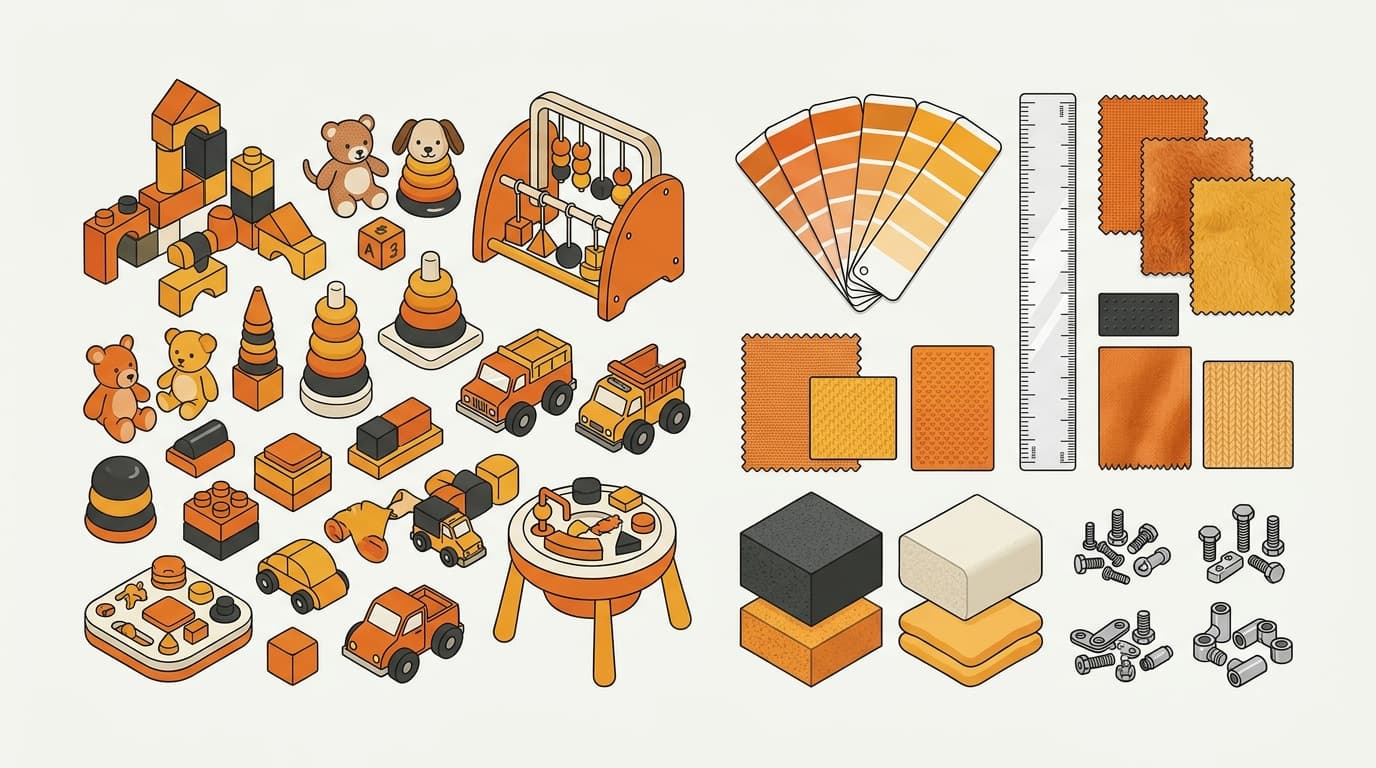
A colorway is not always a cosmetic change. Different dyes, pigments, coatings, prints, finishes, or material formulations can change the product’s chemical-safety results even when the shape, branding, and commercial name stay the same.
This does not mean that every new color automatically requires a separate record. It means the brand should not make that decision from appearance alone. A new color may fit an existing model if its safety-relevant composition is unchanged. The testing or certification body must confirm that the record’s scope includes it.
The most common source of uncertainty is the gap between the catalog description and the factory specification. A product team may see one base fabric in several colors. The factory may be using different dye systems, finishing treatments, pigment compounds, or suppliers. A plastic item may retain the same mold while its color compound or formulation changes. A printed surface may introduce a different ink or finish. These are reasons to ask a scope question, not reasons to assume the color is interchangeable.
Record the customer-facing color name or code together with the safety-relevant dye, pigment, coating, print, finish, formulation, and supplier information.
A color code by itself does not tell the testing body whether composition is unchanged. If a supplier treats a formulation as proprietary, identify the issue early and ask what documentation or samples the body needs. Do not let a seasonal color launch become the first time anyone compares the new formulation with the tested sample.
Size and construction can change physical-safety evidence
A size change is not just a new product photo or catalog code. It can affect dimensions, fit, load or strength, accessible parts, small-part or entrapment risks, and age-use characteristics. A record for one size should not be treated as covering every size in a range without a documented scope decision.
The same principle applies to changes that are less visible than size. Before Korean testing, screen any change to the product’s:
- fabric, plastic, foam, or filling;
- adhesive, hardware, or battery;
- seams, joins, fasteners, or other construction details;
- component specifications or assembly method;
- age grading or expected use;
- manufacturing specifications.
Three practical patterns are worth separating:
- Scaled dimensions: The product keeps the same materials and construction but changes size. The body may be able to group the sizes, but it must consider the physical effect of the change and document the result.
- Changed input: The dimensions stay the same, but foam, filling, plastic, adhesive, hardware, battery, or another component changes. The commercial SKU may look nearly identical while the safety-relevant specification is different.
- Changed construction or use: Materials remain the same, but assembly, accessible parts, fastening, age grading, or use configuration changes. The change can affect the evidence even if the product still belongs to the same collection.
The practical test is not whether the change looks minor in a product meeting. It is whether the change alters an input that supports the safety assessment. If the answer is possibly yes, send the difference to the testing or certification body instead of deciding that the original record carries over.
Build a variant matrix before Korean testing
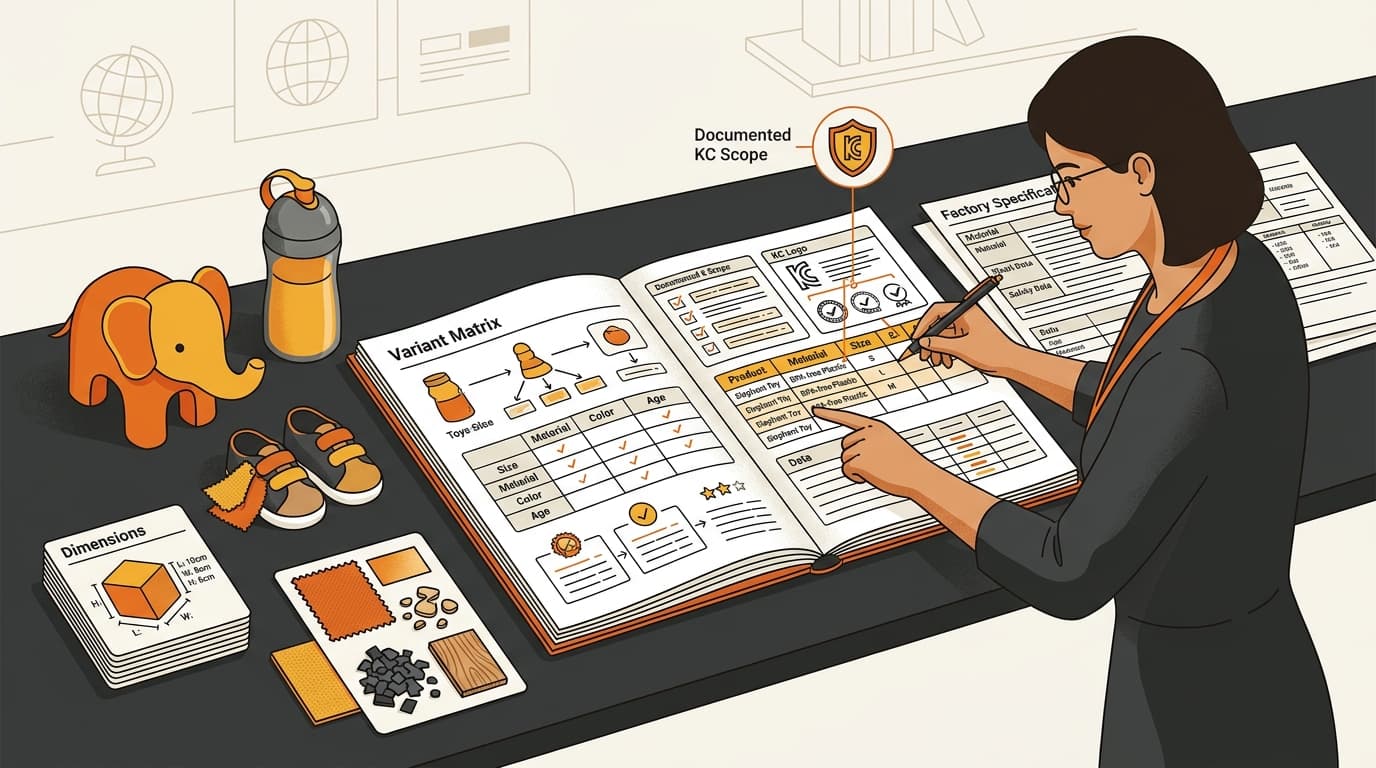
The simplest way to avoid a scope dispute is to show the entire intended range before the first Korean sample is assessed. Do not submit one base SKU and plan to explain the other colors and sizes later. Put every intended SKU on a variant matrix, then let the testing or certification body decide which rows can be grouped under one model or representative product family.
Use one row per sellable variant, even if several rows are later confirmed as covered by the same record. A useful matrix includes the following:
| Field | What to capture | Scope question |
|---|---|---|
| Model identity | Proposed model name, internal model code, SKU, and barcode mapping | Are these variants part of one defined model or only one catalog family? |
| Color and formulation | Customer-facing color plus dye, pigment, coating, print, finish, and relevant supplier or formulation information | Is the safety-relevant composition unchanged? |
| Size and dimensions | Every size, key measurements, fit, and relevant load or geometry differences | Could the physical change affect strength, access, small parts, entrapment, or use? |
| Materials and components | Fabric, plastic, foam, filling, adhesive, hardware, battery, and component specifications | Has any safety-relevant input changed? |
| Construction | Drawings, photographs, seams, joins, fasteners, assembly details, and accessible parts | Is the tested construction the same? |
| Age grading and use | Proposed age grading and the intended use configuration | Does the variant change how or by whom the product is used? |
| Production specification | Factory, process, formulation, revision identifiers, and material-substitution controls | Will production match the sample and the documented scope? |
Then work through the matrix in sequence:
- Freeze the launch range. List the colors, sizes, materials, and constructions you expect to import or list, including variants planned for the near term.
- Choose the reference sample. Identify the product sample or model description that will anchor the review. Do not call it representative of the range until the body accepts that representation.
- Mark every difference. Compare each row against the reference and flag composition, dimensions, components, construction, age grading, and production changes.
- Collect the underlying specifications. Gather the material and component details, color formulation information, dimensions, drawings, and production specifications needed to explain those differences.
- Submit the complete matrix. Give the matrix and relevant samples or evidence to a KATS-recognized testing or certification body under the applicable safety route.
- Get the scope in writing. Ask the body to identify which model names and variants one record covers and which changes require additional samples, revised evidence, or a separate review.
- Map the result back to operations. Connect each covered SKU and barcode to the correct model and record in the product master, purchasing file, Korean marking file, and listing workflow.
A verbal statement that the items are from the same series is difficult to apply later. A written response that names the covered variants and the conditions for grouping gives your sourcing and product teams a usable boundary.
Ask the testing or certification body to use your catalog’s terms. The written scope should name the model, size range, color or formulation, materials, construction, age grading, and production specification. The goal is not only a pass or fail result; it is a boundary your team can apply to the next purchase order and the next SKU.
Use change control after the record is issued
Variant scope is not a one-time launch exercise. Factories introduce new colors, substitute materials, change suppliers, revise foam or filling, replace hardware, alter assembly, or update production specifications after the original review. Product teams may also add a size or change age grading without treating it as a compliance event. Your process needs to catch those changes before import or listing.
Use a pre-launch gate for every new or revised variant:
- Compare the proposed SKU against the approved variant matrix, not only against the product photograph.
- Check whether the color formulation, material, component, battery, dimensions, construction, age grading, or production specification has changed.
- If a safety-relevant difference exists or cannot be verified, hold the variant and send the comparison to the testing or certification body.
- Record whether the body confirms existing scope, requests additional samples or evidence, revises the record, or directs a different testing path.
- Confirm that the physical Korean marking and product information correspond to the covered model and KC record before the item is imported or listed.
A change trigger does not predetermine the outcome. The body may confirm that the existing record covers the variant, or it may require a new sample, revised compliance record, or a different route. The mistake is making that decision internally from the fact that the product still has the same brand name.
Timing matters. If an unreviewed variant reaches Korea, the correction may involve separating inventory, retesting, relabeling, changing product information, pausing a listing, or taking other corrective action. Those are avoidable operational problems when the variant is screened against the record before production and shipment.
A new color or size that is absent from the documented scope is not covered by default because it uses the same logo, collection name, or barcode family. Treat it as a pre-launch compliance question until the applicable body confirms the position.
Common questions about children's-product KC scope
Can one Korean KC certificate cover multiple colors?
Sometimes. Colors may be grouped when their safety-relevant composition is unchanged and the testing or certification body confirms that the defined scope includes them. A new dye, pigment, coating, print, finish, or formulation should be reviewed rather than assumed to be cosmetic.
Can one record cover every size in a range?
Not automatically. Each size should be listed in the variant matrix because dimensions, fit, strength, accessible parts, small-part or entrapment risks, and age-use characteristics can change. The written scope decision—not the size range in your catalog—determines whether one record covers them.
Does every new SKU require a new KC record?
No. A SKU is a commercial identifier, and several SKUs may sit within one accepted model or representative product-family scope. But the new SKU must be mapped to that scope, and any safety-relevant difference must be reviewed before you reuse the existing record.
Is a KC certificate the same as a test report?
No. Depending on the product, the applicable Korean route may be safety certification, safety confirmation, or a supplier’s declaration of conformity, with its own record and evidence requirements. An overseas report or a test result for one variant does not, by itself, establish that every Korean variant is covered.
What if the new variant is already manufactured?
Do not import or list it solely because an earlier model has a KC number. Separate the variant from the approved range, compare its materials, dimensions, construction, and production specification with the matrix, and obtain a written scope decision before relying on the existing record or marking.
Need to map a children's product range before testing?
Bring your model, color, size, material, and production specifications into a Korea compliance review before you import or list the next variant.
About the author
Korean and global e-commerce operators with 15+ years of cross-border experience, led by CEO Isaac Lee — KOTRA-certified consultant and official lecturer for Seoul City and the Korea Customs Service. We run Korea market entry for Western brands every day; this blog documents what we learn in the field.
More about Kontactic →Related Articles
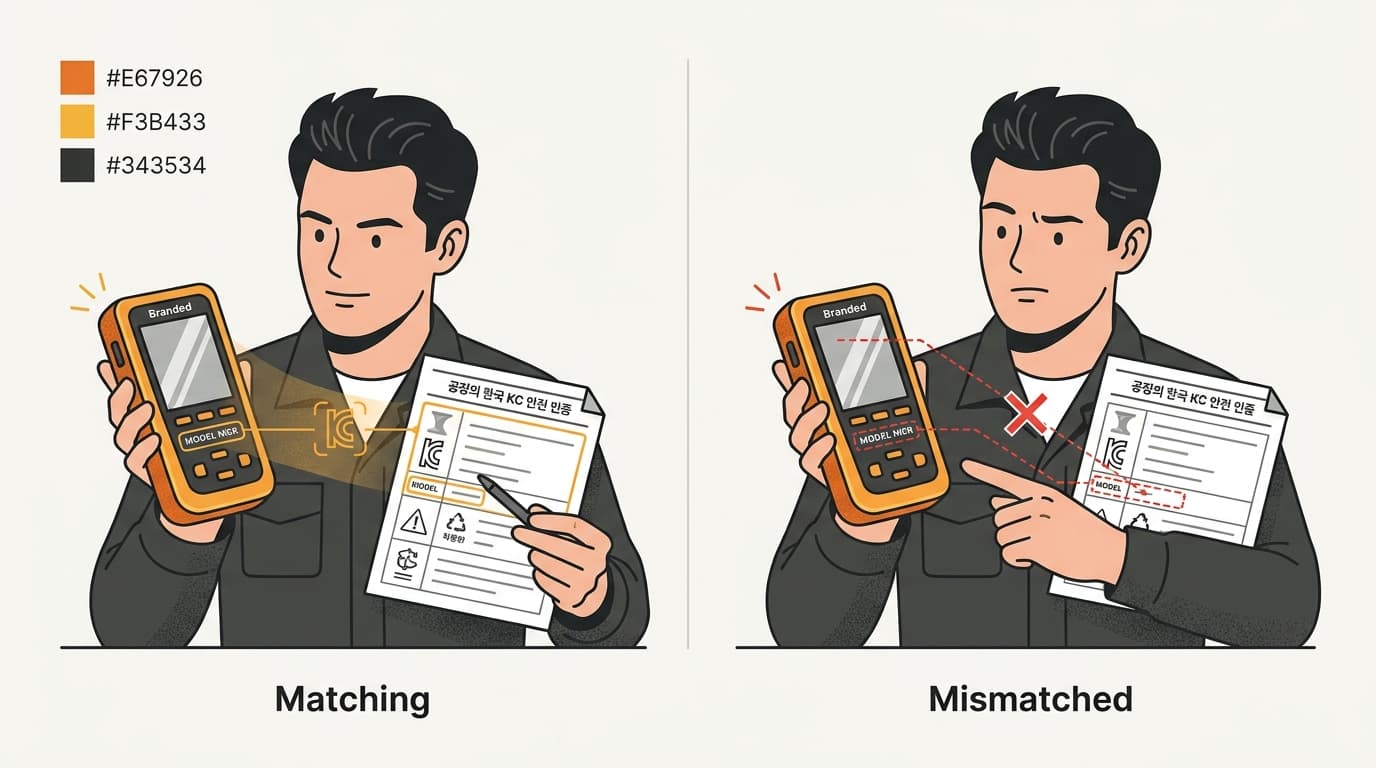
Can a Factory's KC Certificate Cover Your Brand?
Factory KC paperwork covers your private-label product only when the approved model, factory, and version match. Wireless products need a separate RRA check.

Can You Reject a Coupang Exchange? Only Two Reasons
Coupang exchange rejection is limited to SOLDOUT or WITHDRAW. Learn when each code applies—and what to do when a seller simply prefers a refund instead.
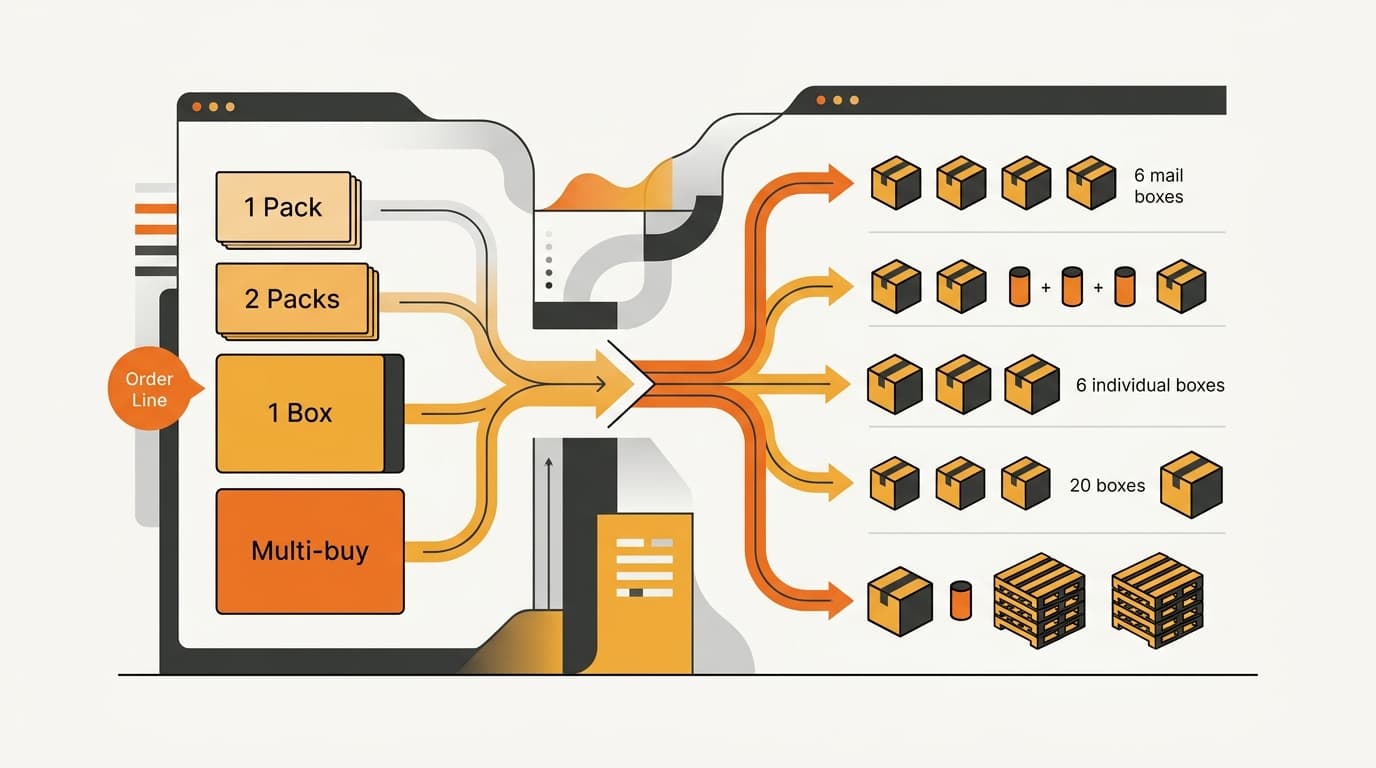
Coupang Order Lines: One Line Is Not One Unit
A Coupang order line can represent a generated quantity option, so your connector must map it to a base SKU and physical quantity before stock movement.