
Can a Non-Resident Brand Be the Korean Importer of Record?
The short answer is no — a non-resident foreign brand generally cannot complete Korean importer registration on its own. The Korean import and product-safety workflows are built around a domestic business registration and a party that can be reached inside Korea for inspection, duties, and recall. That means a Korean entity or an operating partner that already holds import and selling authority is effectively required before you can file anything as importer of record.
This trips up brands that assume "importer of record" is a single form they can submit remotely from the US or EU. It is not a form. It is a bundle of registrations, each one keyed to a Korean identifier and each one presuming someone locally accountable. Below is what those registrations actually demand, and why the prerequisites — not the paperwork — are the real gate.
Why "importer of record" is a bundle, not a license
There is no single universal "Korean importer license" you apply for once. What Korea calls importing a product is really the sum of two things working together: a domestic business identity that can be assessed by tax and customs authorities, and — for most consumer categories — a category-specific import registration filed with whichever regulator governs that product.
The foundation of both is a Korean business registration (사업자등록). Nearly every downstream step — customs declarations, category registrations, VAT filing, even opening the accounts that receive settlement — references this domestic business number. A purely offshore company has no such number, which is why the registration cannot be completed from abroad in practice.
Importer of Record (IoR) in Korea is the domestic party responsible for filing import declarations, paying duties and import VAT, and answering to regulators after clearance. Being that party requires a Korean business registration and a locally reachable responsible person — not a remote filing.
The distinction matters because it changes what you are actually buying when you plan a Korea launch. You are not buying a permit. You are buying a compliant domestic identity plus the specific regulatory registration your product category triggers. If either half is missing, cargo does not clear — or it clears and then cannot be lawfully sold.
For a fuller treatment of who carries this liability once you sell locally, see our explainer on who the importer of record is when you sell on Coupang.
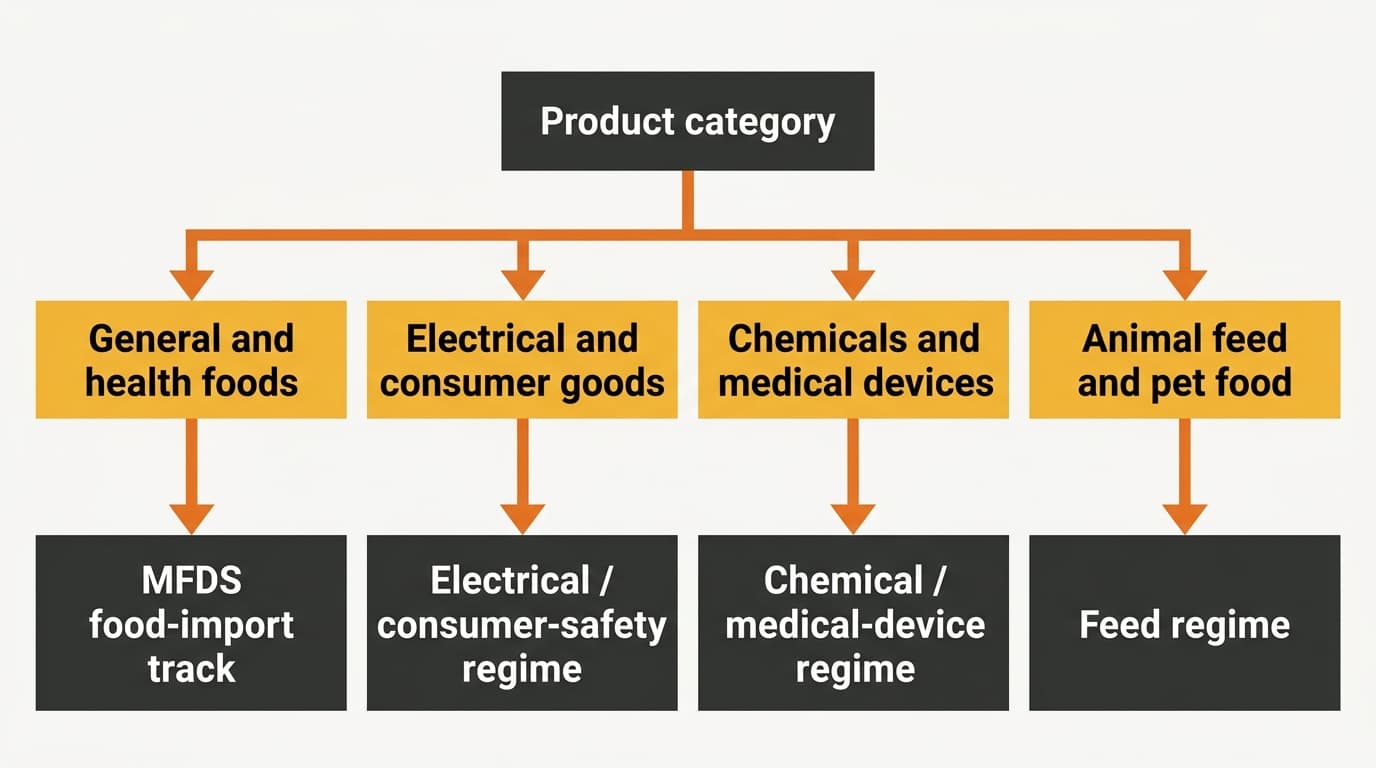
Category routing decides which registration you file
Which registration applies depends entirely on what the product is — and Korea routes categories to different regulators, not to one central importer authority. Getting the routing wrong is the most common way a launch stalls, because the brand prepares the wrong registration and only discovers it when cargo is already in transit.
The main routes work roughly like this:
- General and health foods flow through the Ministry of Food and Drug Safety (식약처, MFDS) under the Special Act on Imported Food Safety Control (수입식품안전관리특별법), registered through the MFDS import-food portal (식품안전나라).
- Electrical and consumer goods route through the electrical- and consumer-product safety regime, which is where KC certification obligations attach.
- Chemicals and medical devices fall under their own chemical and device regimes, each with a distinct registering body and its own pre-market requirements.
- Animal feed and pet food route through the feed regime, separate again from the food track above.
Each of these lands on a different registering body, and each presumes a domestic registrant. This is why "do I need to register as an importer?" has no single answer — it always resolves to "register as an importer of this category, with this regulator, using this domestic business identity." Mapping a product to its exact obligation before shipping is a discipline in itself; we describe how we map each SKU to the right Korean regulation precisely because the routing is easy to get wrong.
The customs layer presumes a domestic party of record
Import declarations run through the Korea Customs Service (관세청) via its electronic clearance system, UNI-PASS. The declaration presumes an identifiable domestic party who can be assessed for duties and import VAT and who remains accountable for post-clearance obligations.
That is the operative constraint. Customs is not simply checking documents; it is recording who is on the hook if duties are reassessed, if a valuation is questioned, or if there is a post-clearance audit. A party with no Korean presence cannot fill that slot, because there is no domestic address, tax identity, or responsible person for the authority to act against.
So even before any category-specific rule, the customs layer alone forces a domestic party of record. The freight forwarder cannot be it. Coupang cannot be it. The offshore parent cannot be it. It has to be an entity with standing inside Korea.
Why the local representative is the actual constraint
Registrations and product-safety accountability attach to a party reachable within Korea — for inspection, for recall, and for administrative action. This is the requirement that a purely offshore structure cannot satisfy, and it is the reason remote filing fails.
Think of it from the regulator's side. If a food product is found non-compliant, the MFDS needs a domestic responsible party to issue a recall order to. If an electrical product fails a market-surveillance check, the safety authority needs someone locally to sanction. A company that exists only in the US or EU offers the Korean authority no one to inspect and no one to compel. The registration frameworks are written around that reachability, so they will not accept a registrant who lacks it.
This is why the representative is not a formality you can appoint casually. The person or entity named is the one the state will hold to account, which is exactly why the workflows insist on a Korea-based responsible party in the first place.
The corporate seal and certificate bottleneck
If you do incorporate your own Korean entity to become the importer, the practical bottleneck is rarely the incorporation decision — it is the registered corporate seal (인감) and seal certificate. Korean corporate filings run on the corporate seal the way Western filings run on an authorized signature, and a foreign owner must navigate seal registration together with representative-director requirements.
A foreign owner setting up a Korean entity commonly underestimates the corporate seal (인감) and seal certificate step. Many downstream filings — banking, customs registration, category registration — depend on a validly registered seal, so a delay here delays everything that follows.
There are second-order requirements too. The entity typically needs a representative director and a real, reachable place of business, and the corporate bank account that eventually receives settlement has its own onboarding friction. None of these are exotic — but they are sequential, and each depends on the one before it. The timeline and capital picture for the most common structure is laid out in our note on yuhan-hoesa setup cost and timeline.

The practical decision: own entity or operating partner
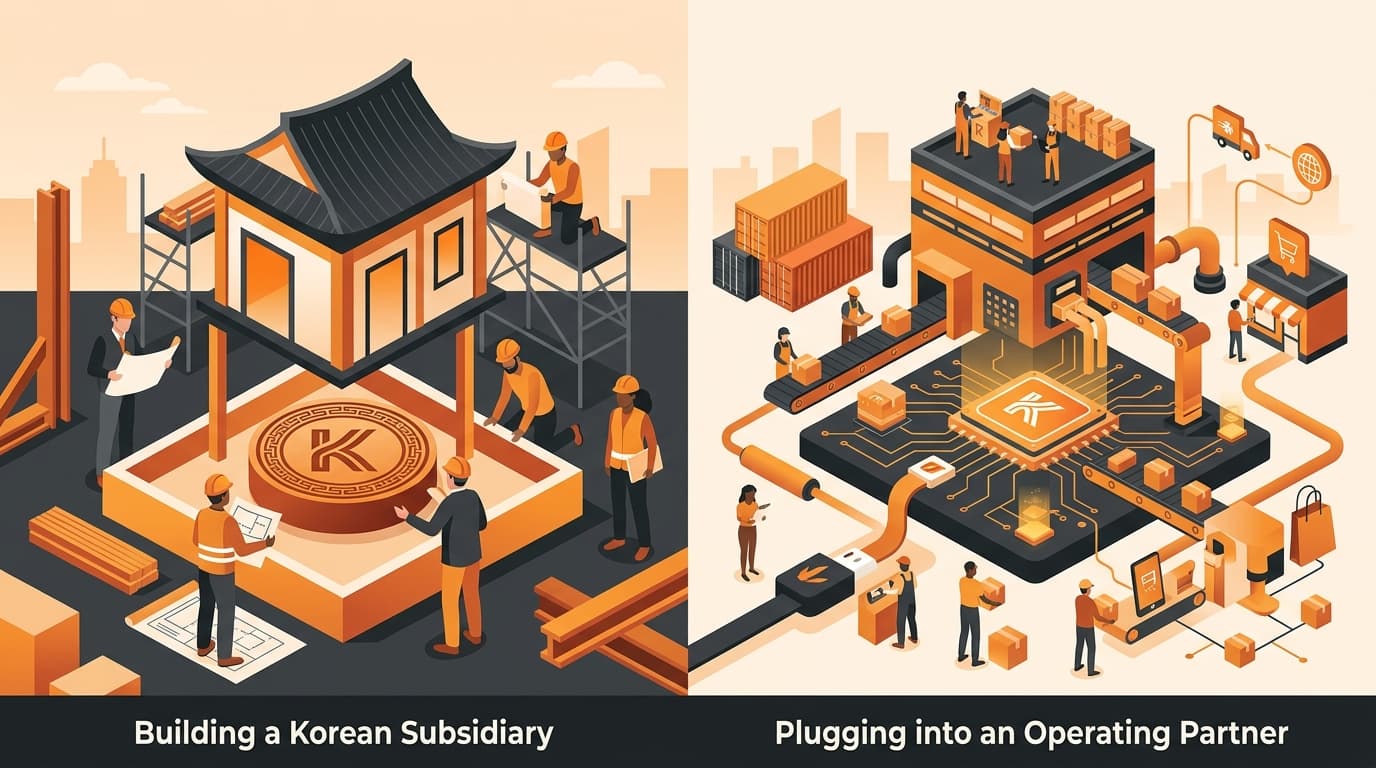
Because the prerequisites are fixed, the real decision reduces to who holds the domestic identity. Brands generally pick one of two paths, and the trade-off is control versus cost and speed.
- Incorporate and administer your own Korean subsidiary. You own the import and selling authority outright, which maximizes control and keeps the entity as a long-term asset. The cost is the setup sequence above — seal, representative director, bank account, category registrations — and the ongoing administrative load of running a Korean company (tax filing, VAT, regulatory correspondence).
- Engage an operating partner that already holds import and selling authority. A partner whose Korean entity serves as the importer and seller of record lets you skip the incorporation sequence and start faster. The trade-off is less direct ownership of the entity and a dependency on the partner's authority and account.
Neither path removes the underlying rule — both exist precisely because a non-resident brand cannot be its own importer of record from abroad. What differs is who carries the domestic identity and how much of the administrative machine you run yourself.
Common questions
Can I just name my freight forwarder as the importer of record? No. A forwarder arranges transport and can assist with clearance, but the importer of record is the domestic party assessed for duties and accountable after clearance. That must be an entity with standing in Korea, not a logistics vendor acting on your behalf.
Is there one "importer license" I can apply for? No. There is a Korean business registration (사업자등록) as the base identity, and then a category-specific registration with whichever regulator governs your product — MFDS for food, the electrical/consumer-safety regime for many devices, and separate regimes for chemicals, medical devices, and feed.
Where can I verify these requirements myself? Primary sources include the statute text on law.go.kr, the Ministry of Food and Drug Safety (식약처) and its import-food portal 식품안전나라 for food categories, the Korea Agency for Technology and Standards (KATS) for product-safety and KC obligations, and the Korea Customs Service (관세청) UNI-PASS system for import declarations. Each portal lets you confirm the registration path for your specific category.
Do these mechanics change by product category? Yes. The registering body, the pre-market requirements, and the exact registration differ by category. The customs and domestic-identity requirements are constant; the category-specific layer on top is what varies.
Not sure which import registration your product triggers?
Kontactic runs the importer-of-record and category registration as a managed function for Western brands going local in Korea. Tell us your product category and we'll map the exact path.
글쓴이 소개
15년 이상의 크로스보더 이커머스 경험을 가진 한국·글로벌 커머스 운영자들입니다. 대표 이이삭 (Isaac Lee)은 KOTRA 인증 컨설턴트이자 서울특별시와 관세청의 공식 강연자입니다. 저희는 매일 서구 브랜드의 한국 시장 진출을 직접 운영하며, 이 블로그에는 그 현장에서 배운 것들을 기록합니다.
Kontactic 더 알아보기 →관련 글
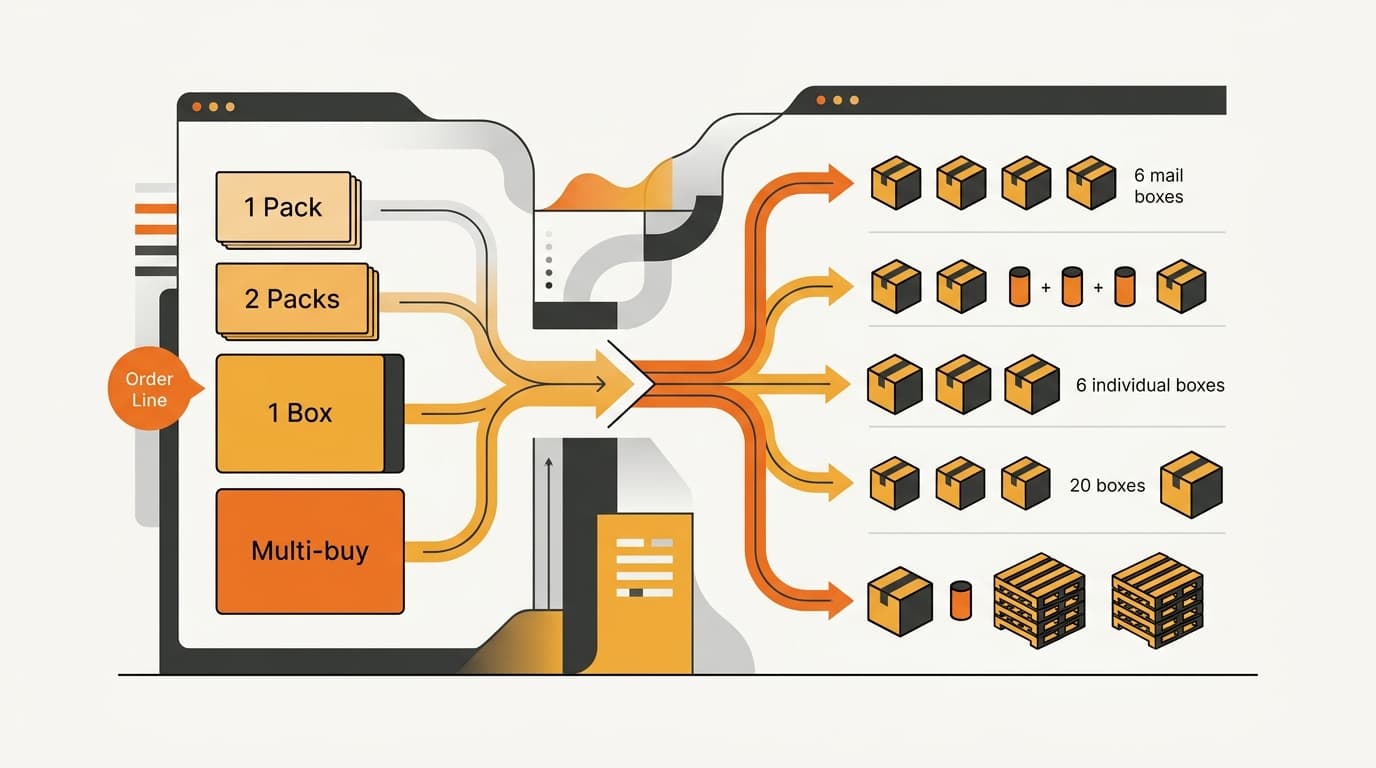
Coupang Order Lines: One Line Is Not One Unit
A Coupang order line can represent a generated quantity option, so your connector must map it to a base SKU and physical quantity before stock movement.
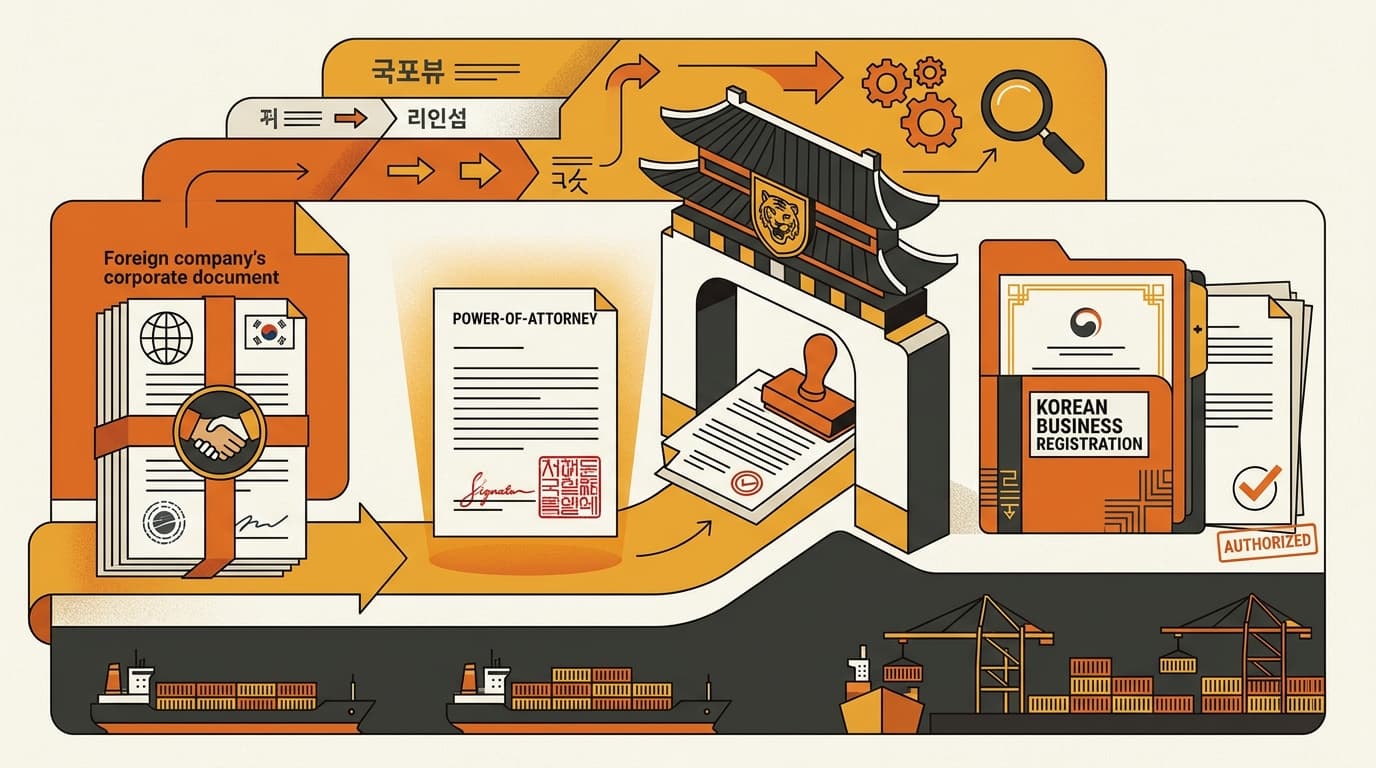
Korean Importer Registration: Why a POA Is Not Enough
A power of attorney cannot establish Korean importer registration; corporate-authority proof and Korean importer records are still required for the filing.
Can You Delay Korea Import Duty on Consignment Stock?
No. Korea import duty and import VAT are normally assessed when consignment stock is cleared for domestic circulation, not when a Korean customer buys one unit.